

e-health strategy
We are in a new era, in which Agentic and LLM AI are rewriting the rules of IT. Modern AI radically improves software economics, while presenting new capabilities of insight generation, partly enabled by the fact that it doesn't care about technical data formats. No domain will feel the revolution more than Health IT (HIT).
Previous HIT strategies that centred on data standards, terminology, and legacy assumptions about how and what solutions should be procured, are now legacy themselves.
Concurrently, investment has poured into AI-based projects in all industries, without understanding its limitations and risks.
A contemporary HIT strategy involves addressing the evolving needs of human healthcare, the needs of medical professionals, and the weaknesses of AI, in order to harness its strengths in a safe way for patients.
Recent book: Roadmap to Successful Digital Health Ecosystems: A Global Perspective, 2nd Ed.Hovenga and Grain; containing four chapters by Thomas Beale.
Hover for more detail ›
Modern AI changes two key activities pertinent to e-health:
Behind both lies the central LLM capability of text prediction. This provides a means of translating data across formats, languages and standards.
Key limitations of LLM AI based environments (not necessarily LLM itself) include:
The first problem can be understood as the ‘straight from text’ problem: in an agentic AI system, source data is accessed as syntax, and goes straight to a black box, which generates output. It is impossible to know what semantics are assumed of the data, or see any reasoning process. The second problem is the lack of connection of semantics to the syntax. The third problem has to do with the partial nature of the data originally accessed, allowing inappropriate conclusions to be generated, and possibly causing patient harm. For many mundane tasks in medicine, such as assistance with writing notes from boilerplate, or summarising large medical texts, these problems will not manifest. For decision support, cohort identification and analytics, they will. However, like fatigue cracking in airframes, they will not initially be visible.
There are sociological risks of AI in healthcare as well: over-reliance by professionals on automated systems (as for pilots on fly-by-wire) may lead to scenarios in which professionals do not know how to proceed on their own.
If AI is to create value in healthcare without creating patient risk or atrophying professional skill levels, new strategies must be developed that account for semantics, traceability, and new modes of training.

openEHR Expertise
Thomas Beale is the original technical architect of the openEHR specifications, including the Reference Model, the Archetype Definition Language (ADL), which is an ISO standard, and an advanced process automation language. He has presented widely on the innovations of openEHR, and worked with numerous ministries and departments of health, regional healthcare jurisdictions, as well as providers like Intermountain Health (Utah), US Veterans Affairs, and many vendors, and has an unparalleled knowledge of the sector.
openEHR remains the most advanced framework for defining and creating clinical data. Nevertheless, how openEHR should be understood today has significantly changed from when it was created. Ars Semantica provides direction for the use of openEHR and related technologies (SNOMED CT, HL7 FHIR etc) within environments in which semantics must now be machine-processable.

SPLASH: a Data Platform for the AI Era
Ars Semantica is developing a next generation open health computing platform — SPLASH — not just for patient data, but for inventory, demographics, encounters, and workflow. The framework integrates ontologies and the domain modelling technology developed in openEHR (archetypes). SPLASH innovations are realisable in today’s openEHR deployments and products.
Hover for more detail ›
The combination of multi-domain application, semantic computability and realtime domain modelling in SPLASH creates a data platform that tracks the domain rather than becoming obsolete, and greatly improves the quality of Agentic AI, which otherwise is limited to numerous highly variable linguistic representations, no standardisation of terms, and no access to ontologic truths.
With the SPLASH platform, decision support and insight generation improve markedly, while hallucination and context-unaware errors are greatly reduced. Many of the innovations of SPLASH can be realised in the current generation of openEHR systems.
Making Standards Cost-effective
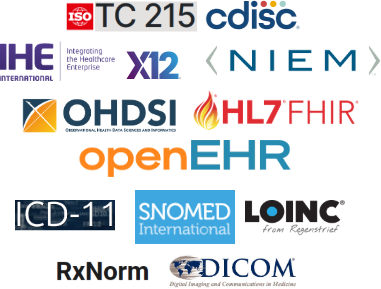
openEHR and SPLASH models (including terminology) are upstream models of domain truth. They are used to generate downstream data interoperability standards artifacts, such as HL7 FHIR profiles. These techniques can radically improve the cost of use of such standards.
Hover for more detail ›
Without common upstream domain models, or a common ontology foundation layer, standards artifacts are guaranteed to create more variation, due to localised and vendor-specific structuring of data and terminology use. This actually worsens the problem, while not addressing the need for a common semantics (i.e. a ‘common language’ of healthcare).
However, with appropriate tools, profiles can be generated from common upstream models, ensuring that even privately created forms still conform to the common semantics.